

News
What Integrated Lyophilization Actually Changes in a Scale-Up
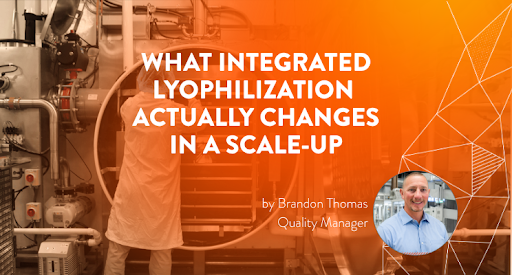
Brandon Thomas has spent more than two decades working across pharmaceutical and medical device manufacturing, from the production floor through quality leadership. That experience shapes a particular perspective on a question most quality leaders eventually face: what happens to your quality system, your lot records, and your cost model when the freeze-drying step lives at a different facility than the rest of your production line? More often than not, the problems that surface at commercial volume trace back to how the production architecture was designed, not whether any single process step works in isolation.
Most contract manufacturers outsource freeze-drying. At Tessy Plastics, lyophilization runs alongside injection molding, precision assembly, and cleanroom kitting under one roof. Here is what that actually changes when a program scales.
The Standard Model and Where It Strains
Most diagnostic and drug-device programs outsource lyophilization to a specialized facility. At a clinical scale, this works. At commercial volume, it becomes the primary constraint; not because freeze-drying fails, but because every handoff between facilities adds risk, cost, and cycle time that compounds as production scales.
Each transfer requires validated shipping protocols, formal receiving inspections, and continuous cold chain documentation [S1]. At low frequency, a quality team can manage this manually. At commercial scale, each transfer becomes a distinct lot boundary, and a quality system built for 50 transfers a year is suddenly managing 500 [S3]. Regulatory mandates under FDA 21 CFR Part 820 and ISO 13485 require total traceability, so poor visibility across fractured supply chains carries real financial and compliance risk [S4].
Cold Chain and Cost
Cold chain between lyophilization and assembly is not just a line item, it’s a quality risk that scales with volume. Liquid reagents typically require expedited shipping on dry ice or frozen gel packs, plus dedicated freezer storage, and even brief temperature excursions can compromise reagent stability [S1]. These costs don’t scale linearly, and for point-of-care and decentralized diagnostics, cold chain dependence restricts geographic market reach [S5].
When lyophilization and assembly share a facility, cross-site cold chain transfers are bypassed. Because lyophilized products are stable at ambient temperature, this layout can offer real savings in transportation, storage, and handling [S1][S6]. In a multi-vendor model, the lyophilization step also carries its own vendor margin, shipping fees, and duplicated quality overhead — a substantial share of total program cost when fully evaluated [S5]. Integrating that step removes an entire category of that overhead rather than just negotiating a better rate.
Lot-Level Continuity
When molding, filling, lyophilization, assembly, and kitting operate under a single quality management system, the lot record can stay continuous instead of requiring cross-site reconciliation. Regulatory compliance under 21 CFR Part 820 and ISO 13485 requires traceability from raw materials through final delivery, extending upstream into the supply base rather than stopping at the finished device [S3]. For antibody-drug conjugate and drug-device combination programs, where multiple high-potency steps are involved, traceability gaps between facilities create real regulatory exposure.
What “Under One Roof” Looks Like
In-house chemists and technical staff develop and optimize freeze-drying cycles tailored to specific biological materials (like enzymes, proteins, or antibodies) within ISO Class 8 cleanroom environments with integrated BSL2 lab capabilities on the same production campus.
As one example: a diagnostic manufacturer needed a full production ecosystem, including specialized lyophilization equipment, stood up rapidly for urgent market demand. The line was stood up and validated in under 15 weeks, against an industry standard typically measured in quarters.
The Real Question
Scaling a lyophilized product successfully is rarely about whether the formulation chemistry is sound – technical evaluators and chief science officers usually already know it is. The question is where lyophilization physically sits in the production architecture, and what that changes about quality, cost, and speed at commercial scale. Companies that scale successfully tend to make that architecture decision early, before a fragmented, multi-vendor model gets locked in and validated.
Brandon Thomas is a Quality Manager at Tessy Plastics with over 20 years of hands-on experience in the pharmaceutical and medical manufacturing industries. His career spans roles from the production floor to quality leadership, providing unique insights into building seamless manufacturing architectures that reduce supply chain friction and improve lot-level continuity. Outside of work, he manages a working farm and is active in the outdoors, including hunting, fishing, and supporting his son’s baseball pursuits. For more details on his expertise, visit Brandon’s LinkedIn profile.
Tessy Plastics is a contract manufacturer specializing in medical device, pharmaceutical, and consumer product manufacturing. With 415 injection molding machines, ISO 13485 certification, FDA-registered facilities, and more than 50 years of experience in medical device manufacturing, Tessy provides end-to-end production from tooling design through final packaged product. For questions or more information contact Katie Romagno at kromagno@tessy.com
[S1] Fortis Life Sciences. ‘Democratizing Molecular Diagnostics with Custom Lyophilized Reagents.’ April 2022. fortislife.com.
[S3] Sanborn Medical. ‘How to Establish Effective Traceability for Medical Device Products.’ January 2026. sanbormedical.com.
[S4] Expandable ERP. ‘Building Supply Chain Transparency with Medical Device ERP Systems.’ March 2026. expandable.com.
[S5] Argonaut Manufacturing Services. ‘How to Eliminate Hidden Cold Chain Costs: Lyophilizing Diagnostic Assays.’ January 2025. argonautms.com.
[S6] Biofortuna. ‘Lyophilization: Eliminating the Need for Cold Chain Logistics.’ November 2025. biofortuna.com