

News
The Multi-Faceted Partner: Why firsthand experience offers unprecedented value in contract manufacturing
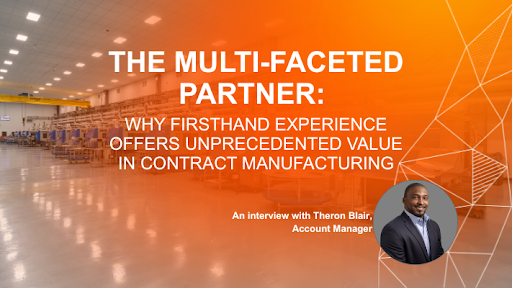
An interview with Theron Blair, Account Manager, on what a career in manufacturing teaches you about partnership
Theron Blair was born in Guyana, South America, where cricket was less a hobby than a fact of life. He describes it as something that has been in his blood since childhood. He moved to Brooklyn at fifteen and worked at a cricket sporting goods store. When he eventually settled in Syracuse, he spent two years driving to New Jersey and New York City every weekend just to stay on the field. That kind of drive does not turn off when you clock in.
At Tessy Plastics, it carried him from the overnight shift on the production floor through nearly every role in the building: operator, certified floor auditor, material handler, setup technician, mold technician, process technician, and finally account management. So when quality, engineering, and commercial show up to the same table, he already speaks their language.
This is a conversation about what customers deserve from a manufacturing partner, told by someone who has seen the work from every angle.
THE INTERVIEW
STARTING ON THE FLOOR
You started on the production floor at Tessy. What did that experience teach you that you could not have learned anywhere else?
Starting on the production floor was extremely beneficial to my growth and development here. I started on the overnight shift, 6 p.m. to 6 a.m. After that first night, I honestly was not sure it was something I wanted to stick with. But I decided to keep going, and I am glad I did.
What it taught me, at its core, was how much the groundwork on the floor affects the entire sustaining process. I started as an operator, then moved into a CFA role, which is a Certified Floor Auditor. From there I became a material handler, then moved into the setup department, where I learned how to set customer molds into our injection molding machines. Then it was mold technician, process technician, and eventually account management.
When I got into this role, I assumed that anyone visiting Tessy with a title like Director, VP, or Manager would already know everything I knew about injection molding. That was not always the case. Customers genuinely valued knowing they had someone on the other side of the table who had actually worked through every one of those steps. During customer meetings, I have connected with various individuals who had a similar path, and those who had not were genuinely excited to hear about what actually happens on the production floor.
Having that background means that when a customer visits and brings people from quality, engineering, and commercial all in the same room, I can speak meaningfully to every one of them. That has been incredibly valuable in building trust.
WHAT CUSTOMERS REALLY NEED
When you moved into the account-facing role, what surprised you most about how customers thought about their contract manufacturing partners?
One of the first things that surprised me was how often customers talked about companies not doing what they say they are going to do. That became one of the most important principles I carry in this role: always do what you tell people you are going to do.
When you think about it from the customer’s side, it makes complete sense. Your customers are making commitments to their own customers around the world, whether it is a consumer component or a medical device that could save someone’s life. If you do not deliver on what you said, you are not just letting down one company. You are potentially affecting a chain of commitments that reaches patients and end users.
Here at Tessy, we do what we say we are going to do. That is why our customers trust us, and it is the foundation of the partnerships I work to grow.
CRADLE TO GRAVE
What does Tessy’s end-to-end partnership actually look like, especially across complex programs in med device and pharmaceutical?
Tessy invests heavily in R&D. That investment matters because not every customer is going to come to you with a product that is already on the market or fully developed. There are plenty of situations where you are helping customers build from the ground up.
Because of that R&D investment, we have what I like to call a cradle to grave capability. We can take a product from a napkin sketch all the way through full production, and then sustain it through the entire lifecycle, whether that means refurbishing to extend the product’s life, or when it reaches end of life, kicking off new tooling, starting the cycle again, and incorporating everything we learned along the way.
That kind of in-house capability gives our customers real confidence. They know that when they come to Tessy, we have the ability from inception all the way through.
THE PILOT-TO-PRODUCTION INFLECTION POINT
Med device and diagnostics OEMs face enormous pressure when scaling from pilot to commercial production. What is the most common mistake you see companies make at that inflection point?
One of the most common mistakes is not building a prototype tool and keeping the pilot and production phases under one roof.
When you visit Tessy, you are going to see a lot of automation running at high volumes. Some customers naturally assume we are a high-volume automation shop and nothing else, and the assumption becomes: start with a smaller shop for the pilot, then come to Tessy when you are ready to scale. That capability exists here, but the assumption keeps companies from taking advantage of it.
What happens when a company splits those phases across two different partners is that institutional knowledge gets lost in the transfer. The second company does not have the full history of what the first one worked through, the process decisions, the challenges, the early learnings. And the time a customer thought they were saving by going elsewhere for the pilot, they may end up spending over again, revisiting, redesigning, adding time and capital to a project that could have stayed on track.
What I love about Tessy is that we prefer to be involved from the very start. We can walk customers through the DFM process, identify potential risks early, and carry that knowledge all the way through to full production. We have taken products from a single-cavity tool all the way up to 128 cavities. Doing that under one roof saves customers real time and real money.
SPEED WITHOUT COMPROMISE
Speed to market and regulatory compliance are always in tension in this industry. How do you think about that tradeoff when you are talking to prospects?
We understand how much speed to market matters to our customers. And one of the things that genuinely benefits both Tessy and those customers is that Tessy is privately owned.
Being privately owned means we do not carry the layers of internal governance overhead that a publicly owned company has to navigate before making decisions. When a customer comes to us with an urgent request, I do not need to send an email and wait. I can walk into the office of our president if I need to. All of our decision makers are under one roof at our corporate headquarters, and we have a genuine open-door policy.
That means we can pull our leadership team together quickly, review what the customer needs, and give them a real answer without holding up their process. In an industry where timing matters as much as it does, that kind of responsiveness is something customers feel the difference of.
PARTNERSHIP UNDER PRESSURE
Can you share a moment where you really felt the partnership was working the way it should, where a customer came away knowing they had made the right choice?
I have a story that is a little different from what you might expect.
It goes back to Hurricane Harvey in 2017. That storm was devastating to a lot of manufacturers. Force majeure situations were creeping up around raw material supply across the industry. At Tessy, one of the things we invest in heavily is raw material inventory. Every one of our manufacturing facilities is outfitted with silos that hold thousands of pounds of resin, and our warehouse also holds finished goods and component stock.
During the storm’s aftermath, one of our customers came to us with an unusual situation. This customer had a product that was dual-sourced, meaning they worked with a second supplier for the same component. That second supplier did not have the raw material reserves that Tessy had, and they were approaching a potential shutdown.
Here is the part that makes this story interesting: that second supplier was a competitor of ours.
Our customer asked if we would be willing to sell some of our raw material to this competitor so they could keep running. The easy answer would have been no. But that is not how we looked at it. The product being manufactured was a medical component, one that supports patient care. We were not going to let our customer’s supply chain go down because of a business technicality.
So we sold our competitor the raw material they needed. They kept running. Our customer’s supply chain held. And we continued to meet our own production commitments at the same time.
What that moment did for the relationship with that customer is hard to put a number on. They came to us because they trusted us enough to make that ask. And we said yes because it was the right thing to do for the people at the end of that supply chain. That is what partnership actually means at Tessy.
WHAT TO ASK ON A FACILITY TOUR
For a company that is early in the search for a manufacturing partner, what should they be asking about? What questions should they bring on facility tours?
I think the single most important thing a company should ask about is: what does your sustaining support look like after a product is in production?
A lot of companies focus most of their attention on the upfront work, the launch process, the tooling, the engineering reviews. That upfront work matters. But sustaining support after launch is where I have seen things fall apart, and it often does not get asked about enough.
At Tessy, every product that comes through the door gets a cross-functional team assigned to it from day one: commercial, quality, automation, engineering, R&D where needed, customer service, and project managers. And that team stays with the product through the full production lifecycle, not just through launch.
It does not matter how well-designed the mold is, or how sophisticated the automation line is. If you cannot get quality parts to your customer on time, everything else is secondary. So when you are touring a facility, ask who is supporting your program in year three. That answer will tell you a great deal about whether a partner is built for the long run or just for the sale.
About the Author
Outside of Tessy, Theron is a father of four and the kind of parent who shows up the same way he does at work. He coached his oldest son in basketball for six years and stays close to each of his kids as they find their own sports and passions. His wife Heather keeps the entire operation running.
He is also an avid football fan who helps run the fantasy football league at Tessy Plastics and built a website of weekly fantasy league recaps, combining a love of creative writing with a love for the game. It started small and has kept growing because of the response it gets from readers.
At Tessy, Theron has spent 12 years building on the invaluable experience he has gained through almost every role in the building.
Tessy Plastics is a contract manufacturer specializing in medical device, pharmaceutical, and consumer product manufacturing. With 415 injection molding machines, ISO 13485 certification, FDA-registered facilities, and more than 50 years of experience in medical device manufacturing, Tessy provides end-to-end production from tooling design through final packaged product. For questions or more information contact Katie Romagno at kromagno@tessy.com